

Morse Code Translator & Reader
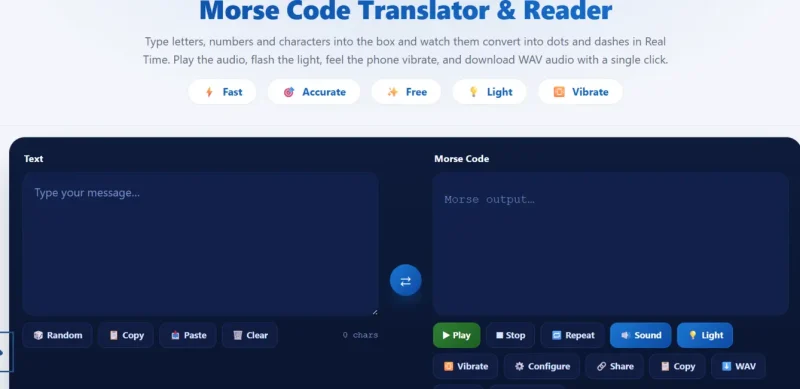
Type letters, numbers and characters into the box and watch them convert into dots and dashes in Real Time. Play the audio, flash the light, feel the phone vibrate, and download WAV audio with a single click.
| Punctuation & Symbols | Morse Code |
|---|
Type a word, a sentence, or a whole paragraph into the translator above and watch it turn into dots and dashes. Swap the function and the tool becomes a Morse code decoder. You can paste in any string of dots and dashes and it reads back as plain English. Once you’ve got your message, hit the play button to hear it as a real CW tone, watch the light blink it out, or feel it buzz through your phone. Adjust the speed in WPM, change the pitch, turn the volume up or down. Download the audio, save the text, or send someone a secret message they’ll have to decode themselves.
This isn’t just a text-to-Morse-code converter, though. If you’re learning shortwave radio, there’s a Farnsworth timing mode built in. If you read Arabic, Hebrew, or Cyrillic, the translator and alphabet reference both support those scripts too. Curious what Morse actually sounds like set to music? Try the Curious what Morse actually sounds like set to music? Try the song player. Want to listen to real Morse signals being sent right now, somewhere in the world? Our live decoder pulls from actual WebSDR receivers. And if you just want the full Morse code alphabet, the spacing rules, or a straight-up A–Z chart, it’s all further down the page. Whether you want to send a quick SOS as a joke, practice CW for amateur radio, or just see your name in dots and dashes, our tool covers all.
How to Use the Morse Code Translator & Interpreter Tool
Follow the steps below to learn how to use our Morse code translator, decoder, and reader. Also, learn how to share secret messages, generate random messages and play audio instantly.
Step by Step Guide to Morse Code Translation
Step 1 – How to Convert Text to Morse Code
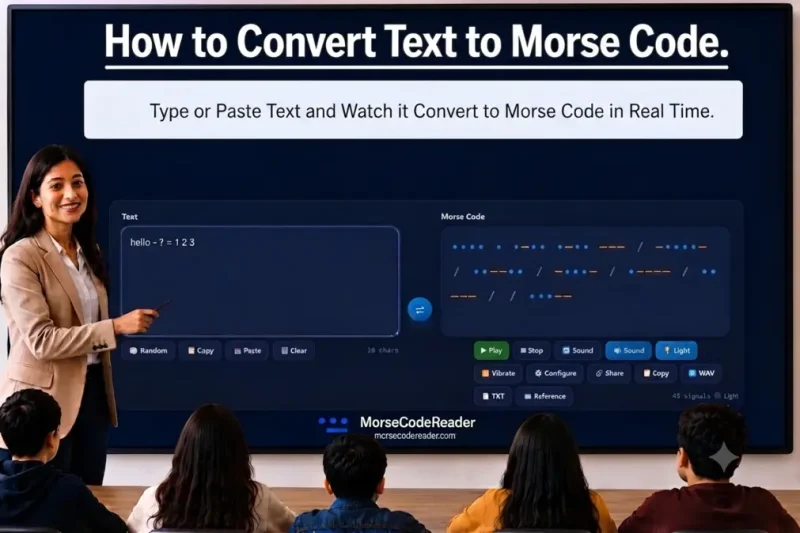
Just paste or type text into the left box and watch it convert into Morse Code in real time.
Step 2 – How to Convert Morse Code to Text
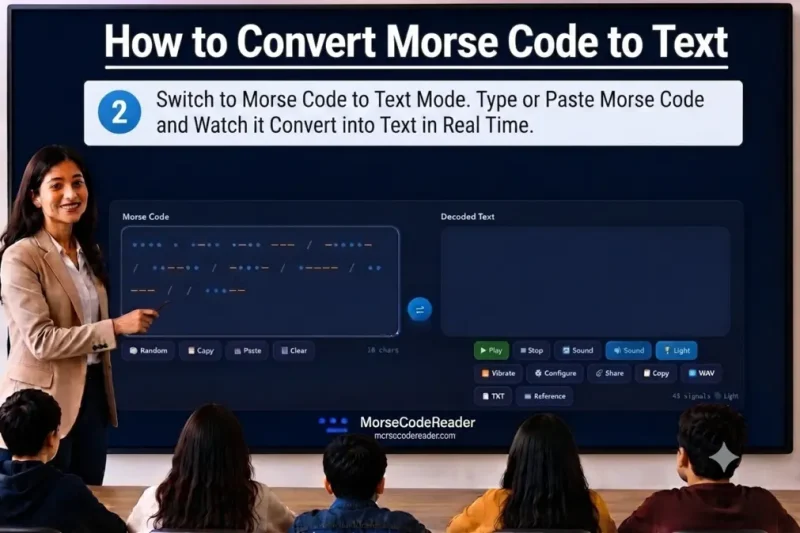
Switch to Morse Code to Text Mode. Type or Paste Morse Code and watch it convert into Text.
Step 3 – Play & Adjust Audio
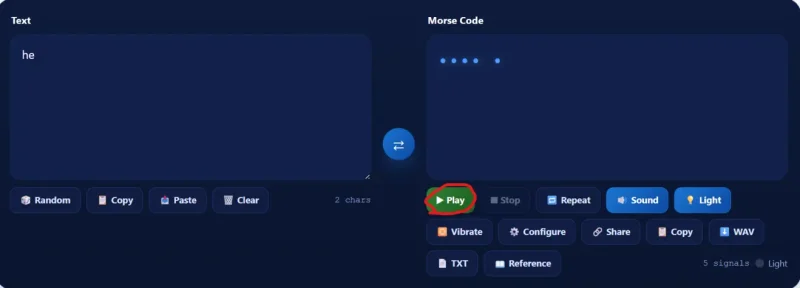
Tap or click on the ‘Play’ button to Play and listen to Morse Code Audio
Step 4 – Download Audio WAV
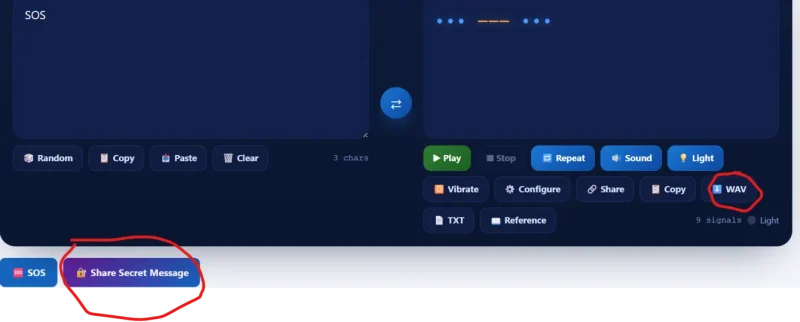
Download audio WAV file and share secret messages.
Step 5 – Generate Random Messages
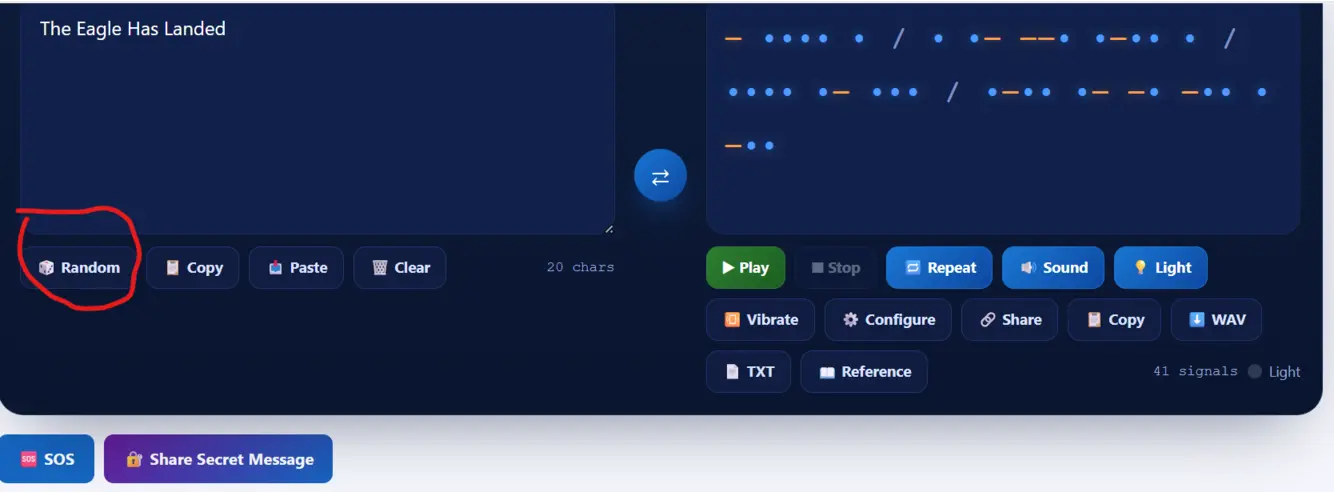
Tap on ‘Random’ button to generate Random messages.
Step 6 – Configure Playback & Scripts
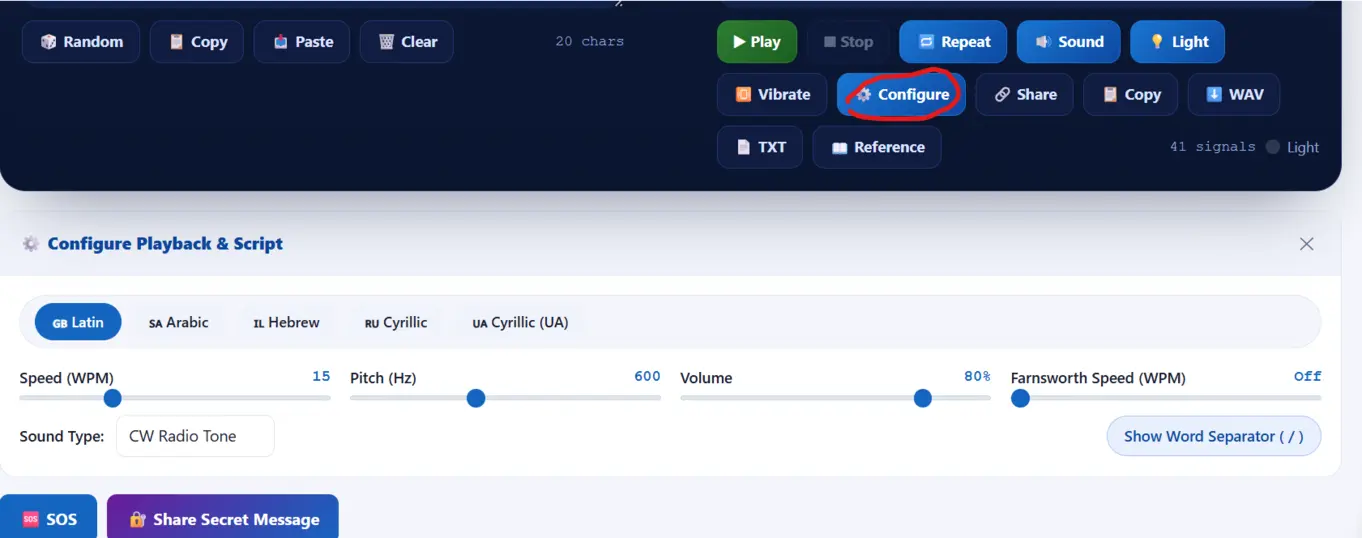
Click on ‘Configure’ button to access more settings
Video Tutorial: Morse Code Translator for Beginners

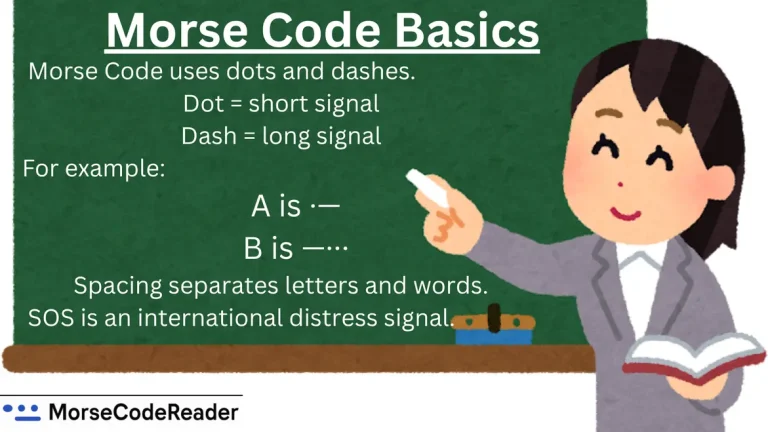
How Does Morse Code Work?
Each letter, number, and punctuation mark has a unique Morse pattern. For example:
A = ·—
B = —···
SOS = … — …
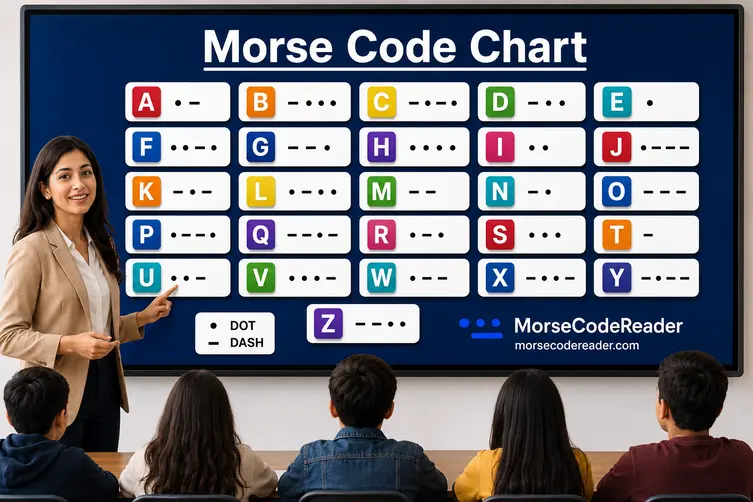
A-Z Chart
The Morse Code A-Z chart below is your complete reference for every letter in the alphabet. Each letter maps to a unique combination of dots (·) and dashes (–) — no two letters share the same pattern, which is what makes Morse code reliable for clear communication. Use this chart alongside the translator tool above to practice recognizing patterns by both sight and sound.
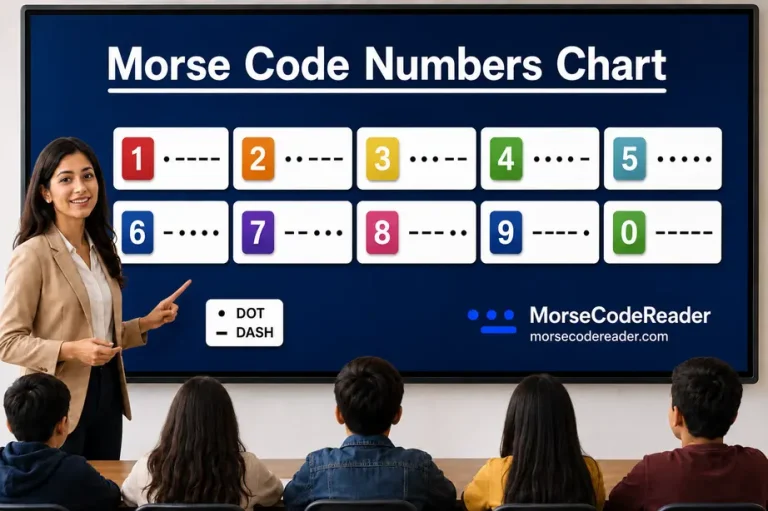
Numbers Chart
The Morse Code numbers chart below covers all ten digits from 0 to 9. Unlike letters, number patterns in Morse code follow a logical structure. For example, digits 1 through 5 begin with dots and end with dashes, while digits 6 through 9 do the opposite, starting with dashes and ending with dots. Zero (—–) is five dashes. This pattern makes numbers one of the easiest parts of Morse code to memorize once you spot the logic. Numbers are widely used in Morse communication for timestamps, coordinates, frequencies, and call signs.
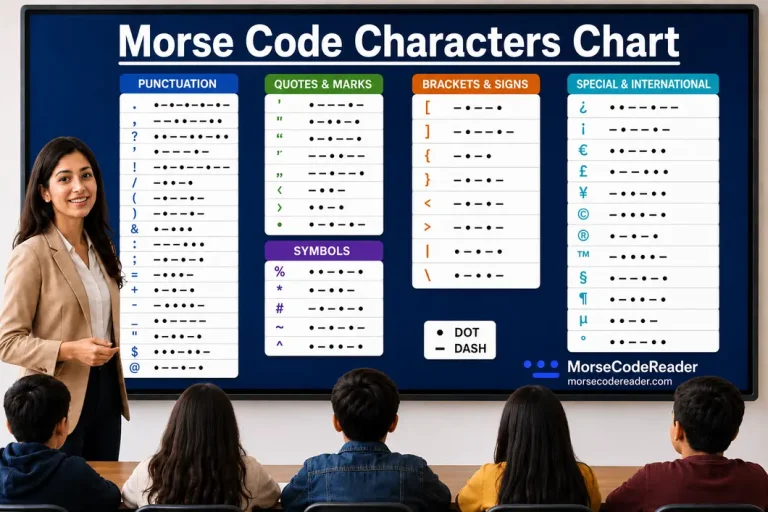
Characters Chart
The chart below covers the most commonly used punctuation marks and special characters in Morse code, including the period, comma, question mark, and more. While characters are used less frequently than letters and numbers, knowing them allows you to transmit complete, properly punctuated messages.
Detailed Spacing Rules
Spaces between signals are just as important as the signals themselves. In Morse code, timing is everything. A short pause (1 unit) separates dots and dashes within the same letter. A medium pause (3 units) marks the end of a letter. A long pause (7 units) separates entire words. This is why the same three dots can mean the letter S or something else entirely depending on the spacing around them. Without correct spacing, even a perfectly tapped message becomes unreadable.
| Pause Duration | What It Separates | Example |
|---|---|---|
| 1 unit | Dots & dashes (within the same letter) | S = · · · (1-unit gaps) |
| 3 units | Letters (end of a letter) | S O S = S (3u) O (3u) S |
| 7 units | Words (between entire words) | HELLO WORLD = 7-unit gap |
Modern tools can instantly convert text into Morse code and decode signals back into readable text using audio, light, or radio-based input.
What Is Morse Code?
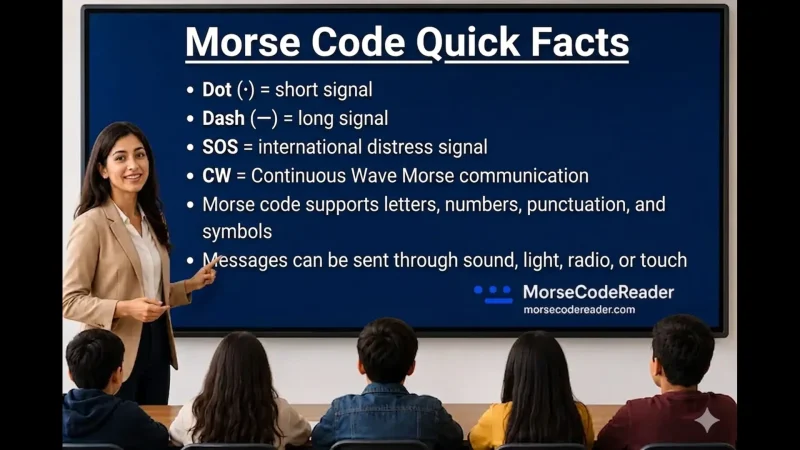
Morse Code is a communication system that represents letters, numbers, and symbols using short signals (dots) and long signals (dashes). Developed by Samuel Morse and Alfred Vail in the 1830s, it is used to send messages through sound, light, radio, and visual signals.
Beyond its historical use in telegraphy, Morse Code remains a fascinating example of an efficient data encoding. To understand why it became a universal standard, let’s take a quick glance at the facts that define its success.
Morse Code Quick Facts
Features of Our Morse Code Translator & Interpreter Tool
We have built comprehensive powerful Morse Code Translator that covers everything. From simple real-time conversion to professional audio controls, multi-script support, and advanced training options. Here is a list of all the features:
| Feature | Description |
|---|---|
| Real-time Text → Morse | Converts text to Morse instantly as you type |
| Morse → Text Decoding | Swap direction and decode dots/dashes to text |
| Multi-Script Support | Latin, Arabic, Hebrew, Cyrillic (RU), Cyrillic (UA) |
| Play / Stop / Repeat | Full audio playback controls |
| Speed Control (WPM) | Adjustable from 5 to 40 words per minute |
| Pitch Control (Hz) | Adjustable from 200 to 1200 Hz |
| Volume Control | Adjustable volume slider |
| Farnsworth Timing | Character speed vs. spacing training mode |
| Sound Types | CW Radio Tone, Telegraph Sounder, Pure Sine |
| Sound Toggle | Turn audio on/off |
| Light Indicator | Flashing light that follows every dot and dash |
| Vibrate | Device vibration in sync with Morse (mobile) |
| SOS Button | Instantly loads the international distress signal |
| Random Message | Generates practice phrases with one click |
| Reference Charts | A–Z, Numbers 0–9, Punctuation & Symbols |
| Download WAV | High-quality 44.1 kHz audio export |
| Download TXT | Save translation as plain text file |
| Copy Text / Morse | One-click clipboard copy |
| Paste | Paste text from clipboard |
| Clear | Instantly clear the input |
| Share Secret Message | Share via WhatsApp, Facebook, Reddit, X, Telegram or link |
| Share Link | Copy direct page link |
| Dark Mode | Toggle between light and dark themes |
| Character & Signal Counters | Live count of characters and Morse signals |
| Word Separator Toggle | Show or hide the “/” between words |
| Colorized Dots & Dashes | Blue dots and orange dashes for easy reading |
| Responsive Design | Works on desktop and mobile |
How to Read and Write Morse Code
Use our Morse Code translator to practice reading, decoding, and interpreting signals in real time.
Morse code is like a secret rhythm language built from short bursts (dots ·) and longer ones (dashes —). Once you lock into that beat, reading, writing, and interpreting it starts feeling natural — especially when practiced with a real Morse code translator.
The Decoding Process: Reading Morse Code
The best way to learn Morse code isn’t rushing into full words — it’s starting slow and building confidence with the easiest letters first. There’s no hurry, and that’s actually the secret to getting good quickly.
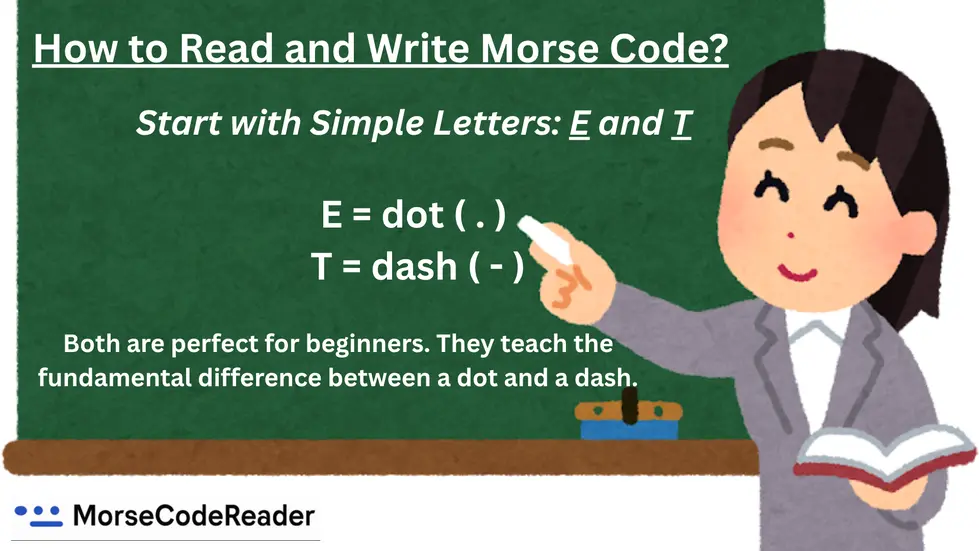
Start with Simple Letters: E and T
These two letters are the foundation of Morse code interpretation, helping you understand how dots and dashes translate into readable meaning.
·
E = dot
Single short signal — the most common letter in English
—
T = dash
Single long signal — the simplest contrast to a dot
These two are perfect for beginners because they teach you the fundamental difference between a dot and a dash — the heartbeat of the entire system. Once you understand this, you can start recognizing and interpreting simple Morse patterns with ease. E is the most common letter in English, so mastering it early pays dividends quickly.
Practice Tips for Reading and Recognizing Morse Code
- Send E and T repeatedly using sound, light, or tapping:
· — · — · —(E T E T E T) - Listen at slow speed (5–10 WPM) using the tool’s audio playback
- Close your eyes and try to recognize them by sound alone — dit vs dah
Quick Overview of Spacing Rules
Understanding spacing is essential for correctly reading and interpreting Morse code messages, as timing determines meaning.
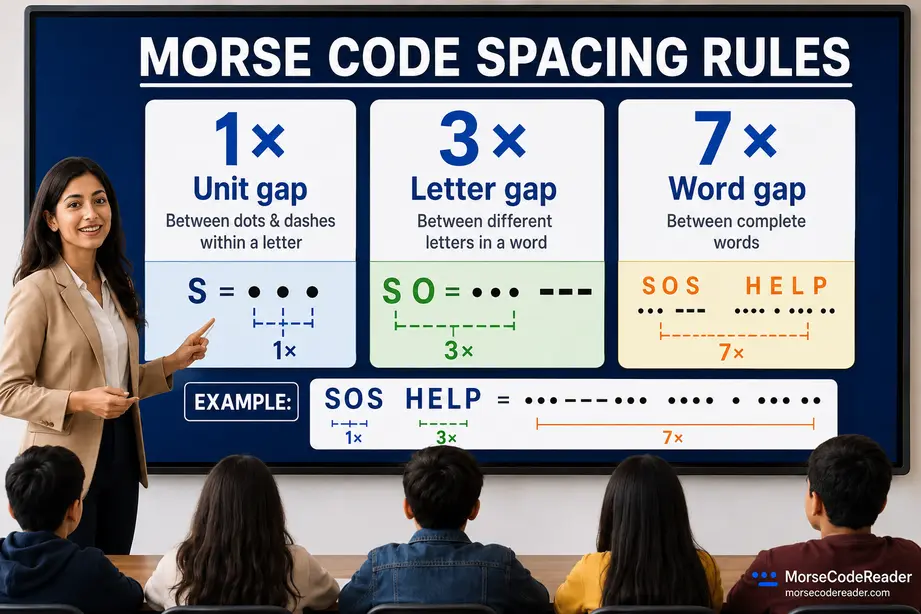
1×
Unit Gap
Between dots/dashes
3×
Letter Gap
Between letters
7×
Word Gap
Between words
Reinforce Memory with Tools and Games
Don’t just learn dots and dashes — use interactive tools, quizzes, and Morse code games to strengthen memory and improve your ability to recognize and interpret Morse code signals. Simulators and light/audio translators make practice fun while boosting retention.Don’t just learn dots and dashes — use interactive tools, quizzes, and Morse code games to strengthen memory. Simulators and light/audio translators make practice fun while boosting retention.
More Morse Code Tools
Practice, play, translate — explore all our free resources
📘 Learn & Practice
🎮 Play & Tools
Pro Tip: When decoding, don’t try to memorize every letter at once. Focus on recognizing the shape and rhythm of each code. With consistent daily practice (even 10–15 minutes), your brain will start automatically translating the sounds — just like learning a new song, which eventually helps you recognize and interpret Morse code effortlessly.
Learn Morse Code with Sound
Morse code is more than dots and dashes on a screen. It’s a rhythmic language of sound. Learning to hear it improves recognition, speed, and retention, helping you better decode and interpret real Morse code messages in practice. The best way as a beginner is to start with something you are passionate about. For example, if you are into music, it can make learning easier for you.
🎵 Learn Morse Code Through Your Favorite Songs
Using famous or your favorite songs can ease your Morse code listening practice and make it more interesting. Familiar melodies help you internalize rhythm patterns naturally — turning dots and dashes into music you already love.
🎼 Morse Code Song Player
Listen to familiar melodies — each note is a Morse dot (·) or dash (—)
💡 Learning Tip: Famous melodies are already stored in your memory. Hearing them as Morse patterns helps your brain recognize dot/dash rhythms naturally — no boring drills required!
🎵 The Melody of Dots & Dashes
Every Morse character has a unique rhythm — a short beep (dot) or a long beep (dash). Start by hearing simple letters like E (·) and T (—) repeatedly to train your ear for recognizing and interpreting Morse code patterns naturally.
🎼 Music-Assisted Learning
Familiar songs like “Twinkle Twinkle” and Beethoven’s “Ode to Joy” become Morse practice tools. Since you already know the melody, your brain focuses on rhythm recognition — making learning faster and more enjoyable.
⏱️ Timing & Farnsworth Principles
Farnsworth spacing slows down messages without altering individual letter rhythm. Practice with varying speeds to improve both recognition and decoding accuracy in real-time interpretation.
🔊 Hear the Code Come Alive
Use audio playback to hear messages in real-time. Playing and repeating messages allows you to internalize rhythm, helping you decode and interpret messages faster over time.
Modern Uses of Morse Code
Today, Morse code is still used in amateur radio (CW communication), aviation beacons, maritime signaling, military training, emergency communication, and survival situations because it works even when other communication systems fail.
Why Morse Code Is Still Relevant
Morse code remains relevant due to its simplicity, reliability, and ability to work without modern infrastructure. It can be transmitted using sound, light, radio, or tapping, making it useful in environments where other communication systems are unavailable.
📻 Amateur Radio & HAM
HAM operators use Morse (CW) to communicate across long distances, even when voice signals fail — often the most reliable method in emergencies.
✈️ Aviation & Navigation
Pilots and air traffic controllers rely on Morse for identifying radio beacons. Each navigational aid has a unique Morse identifier for safe guidance.
🪖 Military & Rescue
Used in survival kits and rescue operations where other tools are unavailable. Can be sent by light, sound, or tapping — making it highly versatile.
🎮 Gaming & Escape Rooms
From digital games to physical escape rooms, Morse is a fun way to encode secret messages and add excitement to challenges.
🎓 Education & STEM
Improves memory, pattern recognition, and coding skills. Teachers integrate Morse into STEM lessons and programming projects to make abstract concepts tangible.
♿ Accessibility & AAC
A lifeline for people with speech or motor disabilities — switches, taps, or eye movements allow efficient communication, demonstrating the code’s enduring role.
📡 Ready to go further?
Understand Live Morse Code Signals in Real Time
Our dedicated Live Morse Code Decoder connects to real WebSDR receivers worldwide, letting you listen to and decode actual CW transmissions — directly in your browser. No hardware, no downloads, no license required.
Why Should You Use the Morse Code Translator
Beyond emergencies and professional use, Morse code is genuinely fun in the modern world. With modern translators and interpreters, you can explore, decode, and understand real messages instantly. Here are the best ways to explore it:
💕 Love & Relationships
- Send secret messages — “I love you” →
.. / .-.. --- ...- . / -.-- --- ..- - Encode romantic names as secret signals
- Use Morse as a secret love language in jewellery or tattoos
🤝 Friendship & Fun
- Share secret jokes only your friends can decode
- Send birthday wishes: “Happy Birthday” in dots & dashes
- Send congratulatory or good luck messages
🎮 Gaming & Pop Culture
- Use Morse in roleplay games (spies, military, survival)
- Encode song lyrics or catchphrases
- Integrate into alternate reality games
📚 Learning & Skill-Building
- Practice translating common phrases
- Used by scouts, cadets, and survivalists
- Amateur radio operators send short, coded messages

The Most Common Morse Code Translations
Try sharing these popular phrases with friends or loved ones. Paste any of them into our translator and interpreter to instantly decode and hear how they sound.
💌 Sentimental & Celebratory Phrases
I love you
A timeless expression of affection. Use this to convey deep emotional connection across any distance, whether through Morse code or traditional means.
.. / .-.. --- ...- . / -.-- --- ..-I miss you
Express longing and nostalgia. Perfect for long-distance relationships or reconnecting with someone after time apart.
.. / -- .. ... ... / -.-- --- ..-Good luck
Offer encouragement before important events. Whether it’s an exam, interview, or performance, this phrase provides positive reinforcement and support.
--. --- --- -.. / .-.. ..- -.-.Happy Birthday
Celebrate someone’s special day with this festive greeting. A unique way to mark the occasion and make them feel cherished and remembered.
.... .- .--. .--. -.-- / -... .. .-. - .... -.. .- -.--Best friends forever
Solidify your bond with this timeless phrase. Ideal for cementing lifelong friendships and showing unwavering loyalty and commitment to someone special.
-... . ... - / ..-. .-. .. . -. -.. ... / ..-. --- .-. . ...- . .-.SOS (Emergency)
The international distress signal. Recognized worldwide as an urgent call for help. Use only in genuine emergency situations requiring immediate assistance and rescue.
... --- ...143 (I Love You)
A numeric shorthand popular in digital communication. Represents the letter count in each word: “I” (1 letter), “Love” (4 letters), “You” (3 letters). A clever, modern twist on classic affection.
.---- ....- ...--Crush
Encode the name of your crush, or send this word itself as a hint — a subtle way to test the waters without saying it outright.
-.-. .-. ..- ... ....I Miss Her
A quiet way to express longing for someone specific. Works well shared privately, away from a public feed.
.. / -- .. ... ... / .... . .-.Badass
A confident compliment for someone who’s fearless, bold, or just plain impressive. Fun to encode as a nickname or inside joke.
-... .- -.. .- ... ...😏 Cheeky & Sarcastic Phrases
I Hate You
A blunt expression of anger or frustration. Sometimes used jokingly between friends, sometimes literally — context matters.
.. / .... .- - . / -.-- --- ..-I am Sorry
A sincere apology. Useful for mending a friendship, admitting a mistake, or reaching out after a disagreement.
.. / .- -- / ... --- .-. .-. -.--Ur Cute
A playful, casual compliment — perfect for texting a crush in a way only Morse code fans will understand.
..- .-. / -.-. ..- - .You’re Dumb
A cheeky jab between friends. Best kept light-hearted — tone doesn’t always translate well over dots and dashes.
-.-- --- ..- .-. . / -.. ..- -- -...STFU
A well-known internet acronym. Encoding it in Morse turns a blunt message into a bit of a puzzle for the recipient.
... - ..-. ..-⬆ Click to scroll up to the Morse code translator & craft your own message
Why Choose This Morse Code Translator
⚡
Instant & Accurate
Converts text to Morse and back with zero lag — precise every single time, for short signals or long messages.
🎯
Clean Interface
No steep learning curve. Beginners love the simplicity; experienced users appreciate the reliability and speed.
🆓
Free & Ad-Free
Completely free, no sign-ups, no tracking, no pop-ups. Just a clean, secure tool you can use anytime.
🔒
Privacy-Focused
Everything runs in your browser. Your messages never leave your device — complete privacy, always.
🎵
Play Songs to Learn Morse Audio
Learn Morse code through famous melodies like “Twinkle Twinkle” and Beethoven’s “Ode to Joy.” Familiar songs make rhythm recognition natural and fun — no boring drills required.
📊
Real-Time Visualizer
Watch dots and dashes light up as audio plays. The live visual feedback helps connect what you hear with what you see — accelerating learning and decoding skills.
🎧
Live Interpreter
Instantly decode and interpret real CW transmissions from WebSDR receivers worldwide in real time.
How to Improve Your Morse Code Skills Using a Translator & Interpreter
You can improve faster by practicing with a Morse code translator and interpreter that gives instant feedback while you learn. Here’s a simple, effective way to level up quickly:
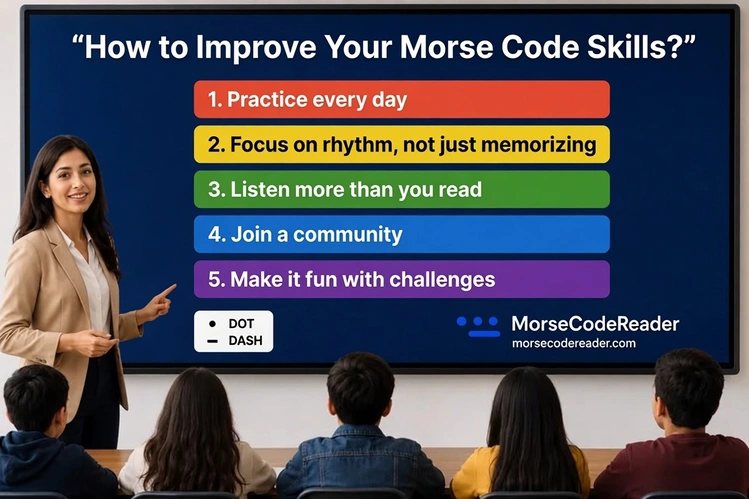
Practice every day
Even 10–15 minutes daily makes a huge difference. Consistency beats long, infrequent sessions.
Focus on rhythm, not just memorizing
Train your brain to recognize the “sound shape” of each letter instead of counting dots and dashes. This is the fastest way to improve.
Listen more than you read
Use audio practice. Close your eyes and try to decode messages by ear. It strengthens listening skills dramatically.
Join a Community
Connect with learners on forums, Reddit, Discord, or HAM radio clubs. Sharing tips and practicing together keeps you motivated.
Make it fun with challenges
Decode random messages, try speed tests, or play Morse code games. Turning practice into a game helps you improve faster and enjoy the process.