
What do you visualize when you think of a Morse Code Machine? Do you see a long series of dots (…..) and dashes (—-). Well, that is how most people perceive Morse code.
However, a Morse Code machine is way more than just dashes and dots. It has been a revolutionary invention that completely changed the way communication took place. Morse Code was the first tool that made global connectivity possible using signals during the 19th and early 20th centuries.
While the internet dominates the modern technological sphere by leaps and bounds, Morse Code remains a fascinating tool among hobbyists, educationists and tech enthusiasts. Let’s explore Morse Code Machine in more detail in the next sections.
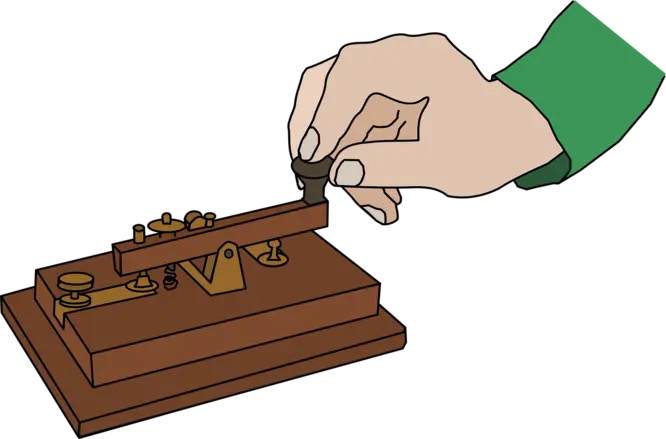
What is a Morse Code Machine?
A Morse code machine is a physical device that was designed to send and receive messages using the Morse code system. It entails a method of encoding letters, numbers, and punctuation into sequences of short and long signals—commonly referred to as dots (•) and dashes (—).
When Morse code machines were first invented, they represented telegraphs that used electrical pulses sent through wires in the form of dots and dashes. As it evolved with time, it was used as radio transmitters, including some other devices that made wireless communication possible.
Morse Code Machine comprises two main functions:
- Transmission – allowed sending signals by using a telegraph key, producing short or long electrical impulses.
- Reception – received the transmitted signals either on paper tape or as audible beeps that were translated back into readable format by the operators.
Who was the Brain Behind Morse Code Machine
Samuel Morse, an American painter, was the inventor of Morse Code. Way back in the early 1830s, Morse and his partners developed the telegraph system that would soon revolutionize communication. In 1844, the first official telegraph message—“What hath God wrought”—was sent from Washington D.C. to Baltimore.
How Does a Morse Code Machine Work?
The operation of a Morse code machine is simple yet brilliant:
- Telegraph Key – The sender pressed a lever (key) to complete an electrical circuit. A short press made a dot, while a longer press made a dash.
- Transmission Line – The electrical signal travelled through a wire or was sent wirelessly via radio waves.
- Receiver – The recipient’s machine recorded these signals as clicks, tones, or marks on paper tape.
- Decoding – This process consisted of translating the dots and dashes back into their original form – numbers, letters or words.
The reason why Morse signals were highly reliable because they could be decoded using sound, light, or even vibrations.
Types of Morse Code Machines
Over the years, Morse code machines were developed into multiple variations:
- Manual Telegraph Machines: Being the first devices, these simply comprised a key and a receiver.
- Automatic Telegraph Machines: They were more enhanced versions that used punched tape to speed up sending messages.
- Wireless Morse Machines: They were primarily used in ships and radio stations to transmit signals using wireless connectivity.
- Modern Electronic Devices: Even in the modern world, enthusiasts build digital Morse code machines using microcontrollers. For example, Arduino and Raspberry Pi.
What is the Relevance of Morse Code Machines Today
While you may not find Morse code machines in everyday use in the modern world, they are still relevant:
- Amateur Radio (Ham Radio)
- Aviation and Navigation
- Emergency Communication
- Education and Hobby
Fun Facts About Morse Code Machines
- The word “SOS” doesn’t stand for anything. It was chosen because its dot-dash pattern (· · · — — — · · ·) is easy to recognise.
- When World War II was being fought, resistance groups used Morse machines hidden inside household items.
- Besides, people with hearing impairment or other disabilities also use Morse code using adaptive devices to communicate.
Conclusion
Considered as one of the most revolutionary inventions of the 19th century, Morse Machine changed the way people connected across distances. While modern technology plays a dominant role, the Morse Machine still remains an iconic marvel. You can use our Morse Code Translator to explore how you can still use it.