
Morse Code Alphabet
Learn the complete official International Morse Code alphabet with A–Z letters, numbers, punctuation, audio playback, tapping practice, and an interactive encoder. This ITU-standard morse code chart includes the official A–Z letter mappings used worldwide in ham radio, aviation, and emergency communication.
International Morse Code Alphabet A–Z
ITU-R M.1677-1Official International Morse Code Chart (A–Z Letters)
| Letter | Morse Pattern | Phonetic (NATO) | Mnemonic | Listen |
|---|
Source: Based on the official ITU-R M.1677-1 International Morse Code standard for letters A–Z, numbers, and punctuation.
🔤 Deep-Dive: Every Letter
Audio trainers, history & practice drills
Each letter page includes its own morse chart, phonetic name, audio trainer, and tapping drill.
American Morse Code Alphabet A–Z
Original 1837📟 View American Morse Code A–Z comparison table Historical reference · click to expand
| Letter | American Pattern | International | NATO Word | Listen |
|---|
Morse Code Alphabet with Numbers
Complete Reference🔢 Explore Each Number
Audio, history & practice
Each number page covers its morse pattern, audio, history, and a dedicated tapping drill.
| Numeral | Morse Pattern | Memory Tip | Listen |
|---|
| Symbol | Name | Morse Pattern | Listen |
|---|
| Prosign | Meaning | Pattern |
|---|---|---|
| AR | End of message | .-.-. |
| SK | End of contact | …-.- |
| KN | Go ahead (specific station) | -.-. |
| BT | Break / new paragraph | -…- |
| SOS | International distress signal | …—… |
| CQ | General call / seeking contact | -.-. –.- |
| 73 | Best regards | –… …– |
| 88 | Love and kisses | —… —… |
Morse Code Encoder — Text to Morse
Interactive ToolMorse Code Tapping Practice
Interactive DrillPause 1.5 s between letters · 3 s between words · Press Space to clear
How To Use the Morse Code Alphabet
Beginner Guide| Element | Duration | What It Means |
|---|---|---|
| Dot (dit) | 1 unit | The base timing unit — shortest sound |
| Dash (dah) | 3 units | Three times a dot length |
| Intra-character gap | 1 unit | Silence between dots/dashes within one letter |
| Inter-character gap | 3 units | Silence between two different letters |
| Word gap | 7 units | Silence between complete words |
🎧 Koch Method
Start with just 2 characters (usually K and M) at full speed (20 WPM). Add a new character only once accuracy exceeds 90%. Proven most effective for long-term muscle memory — used in ARRL licensing courses worldwide.📻 Farnsworth Method
Send each character at full speed but increase inter-character gaps. Lets you hear the correct rhythm of each letter without rushing between them — ideal for absolute beginners building confidence.🖐️ Tapping Practice
Use the Tapping tab above. Physical tapping builds tactile memory needed for a real telegraph key or iambic paddle. Even 10 minutes of daily practice produces measurable improvement within a week.🔤 Phonetic Anchors (NATO)
Pair each letter with its NATO phonetic word (Alpha, Bravo, Charlie…). In real radio communications, operators say “Golf” not “G” — the phonetic name becomes inseparable from the morse pattern.📻 Amateur (Ham) Radio
CW (Continuous Wave) Morse remains active on HF bands worldwide. Operators prefer it for its ability to punch through weak signal conditions where voice communication fails entirely. ARRL sponsors regular CW contests.✈️ Aviation Navigation (VOR/NDB)
VOR and NDB beacons still broadcast their 2–3 letter identifier in Morse every 30 seconds. Pilots learn to identify beacons by ear — a direct, real-world application of the morse code alphabet every day.🏥 Assistive Communication (AAC)
Morse is increasingly used in AAC devices for people with limited mobility. Two-switch Morse input enables text entry at surprisingly high speeds and is supported natively by modern accessibility software.🌊 Maritime & Emergency Safety
The SOS distress signal (· · · — — — · · ·) is recognised internationally. Morse light signals remain a backup ship-to-ship communication method in emergencies when electronic systems fail.What is the Morse Code Alphabet? Understanding the Dots and Dashes
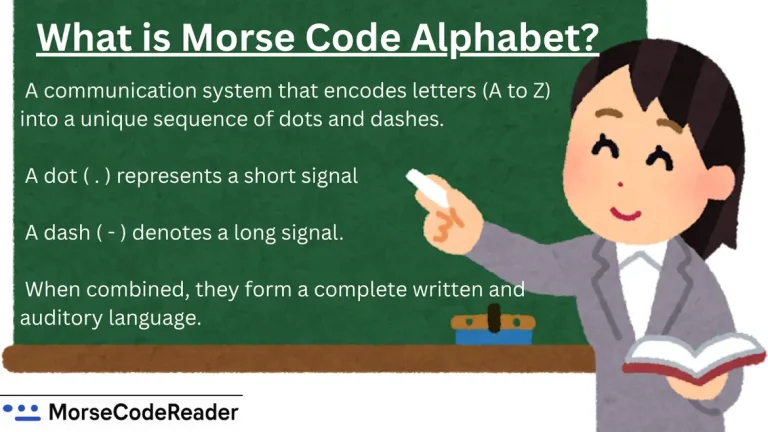
The morse code alphabet is a communication system that encodes every letter A to Z into a unique sequence of dots and dashes. While each dot represents a short signal, a dash denotes a long one. When combined, they form a complete written and auditory language.
The founders, Samuel Morse and Alfred Vail, developed the system in the 1830s for use with the electric telegraph. Their goal was to send written messages across wire at the speed of electricity. What they created became the foundation of modern long-distance communication.
What is the International Morse Code?
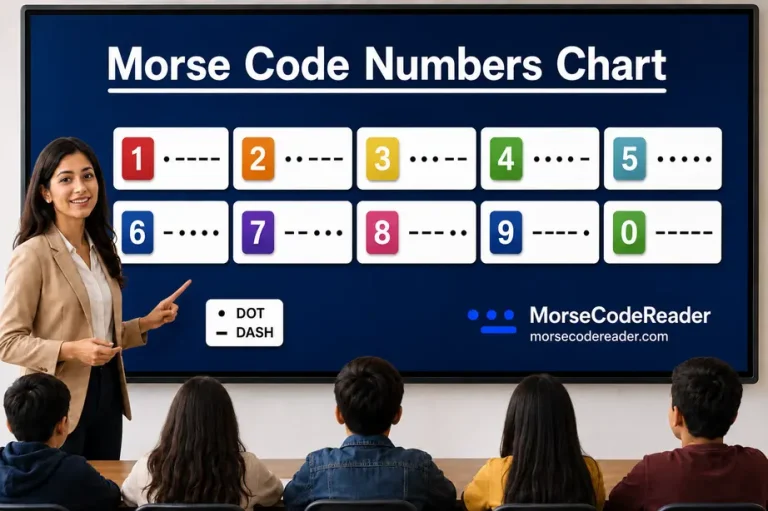
The International Morse Code is the version used globally today. It covers the full A–Z alphabet, numerals 0–9, and a set of punctuation and procedural signals called prosigns.
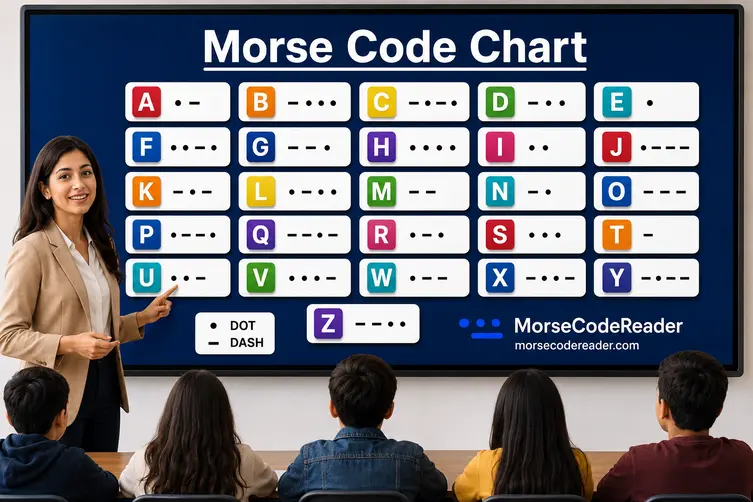
What makes the system elegant is its logic. The most common letters in the English language get the shortest codes. E is a single dot. T is a single dash. Less frequent letters like Q and Z use longer combinations. This design reduces transmission time, helping make a practical decision built directly into the alphabet itself.
Morse is not just historic. It remains an active standard in amateur radio (ham radio), aviation navigation, and emergency communication. You can decode it by ear, by eye, or by touch (tapping), making it one of the most versatile encoding systems ever devised.
Use our morse code interpreter to translate any letter, word, or phrase instantly.
How Morse Code Alphabet Translates Letters (A to Z) into Signals
Every letter in the morse code alphabet A to Z maps to a fixed pattern of dots and dashes. There are no exceptions. Once you know the rules, the system is entirely predictable.
The Two Building Blocks
All morse code is built from two signals:
- Dot (dit) — a short signal. This is the base unit of time.
- Dash (dah) — a long signal. Exactly three times the length of a dot.
How Spacing Works
Timing is not optional in morse code — it is the message. Here is how silence is structured:
- Between dots and dashes within a letter: 1 unit of silence
- Between two letters: 3 units of silence
- Between two words: 7 units of silence
Miss the spacing and the message breaks down. This is why learning rhythm matters as much as learning the patterns themselves.
Frequency Bias in the Design
Morse code was not assigned randomly. Vail analyzed letter frequency in English text — reportedly by counting typeface letters in a printer’s shop — and gave shorter codes to more common letters. The result:
- E (most common English letter) =
.— one dot only - T (second most common) =
-— one dash only - A =
.- - I =
.. - M =
-- - Q (rare) =
--.-— four elements
This means fluent operators naturally transmit common words faster. The efficiency is baked into the morse code alphabet chart itself.
International vs American Morse
There are two versions of the morse code alphabet. The International Morse Code (ITU standard) is used worldwide for radio, aviation, and maritime. The older American Morse Code, used on 19th-century telegraph lines, differs for several letters, particularly C, F, J, L, O, P, R, X, Y, and Z. Some American codes include internal gaps and two dash lengths. The interactive tool above lets you compare both side by side.
Morse Code Alphabet Chart
The complete morse code alphabet chart for A to Z is displayed in the interactive tool above. Each letter shows its ITU-standard dot-dash pattern, its NATO phonetic equivalent (Alpha, Bravo, Charlie…), a memory mnemonic, and a play button to hear the tone at the standard 650 Hz reference frequency.
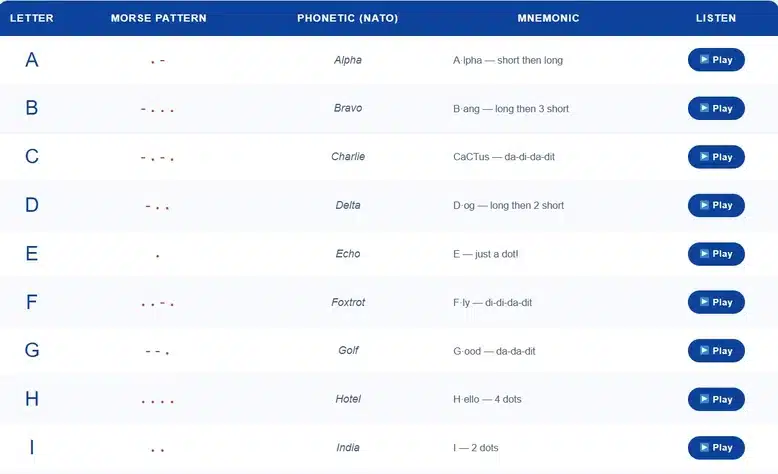
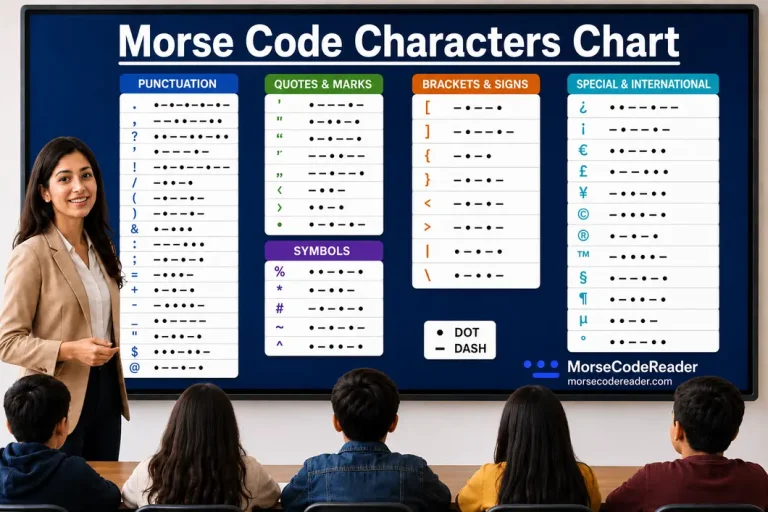
The chart also covers the morse code alphabet with numbers 0–9, common punctuation marks, and widely used prosigns like SOS, AR, and SK. To see the American Morse version of the alphabet, switch to the American tab at the top of the tool.
For a morse code alphabet printable or morse code alphabet PDF version, open the International A–Z tab and use your browser’s Print function (Ctrl+P or Cmd+P). The table layout is designed to render cleanly on a single printed page.
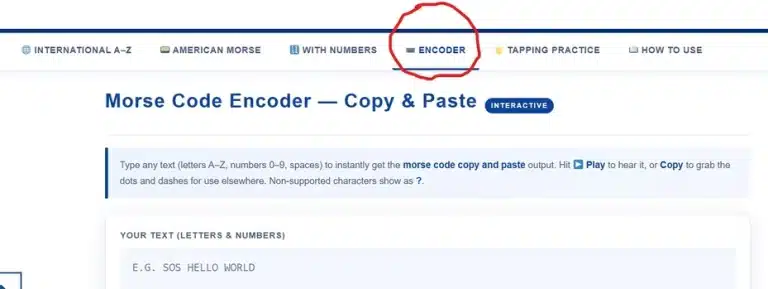
Need to morse code alphabet copy and paste your encoded text? Use the Encoder tab in the tool. Type any word, hit Copy, and paste the dots and dashes anywhere you need.
A Step by Step Guide to Learning Morse Code Alphabet
Learning the full morse code alphabet A to Z takes consistent practice, not a single cramming session. The methods below are drawn from techniques used by licensed amateur radio operators and ARRL (American Radio Relay League) training programs.
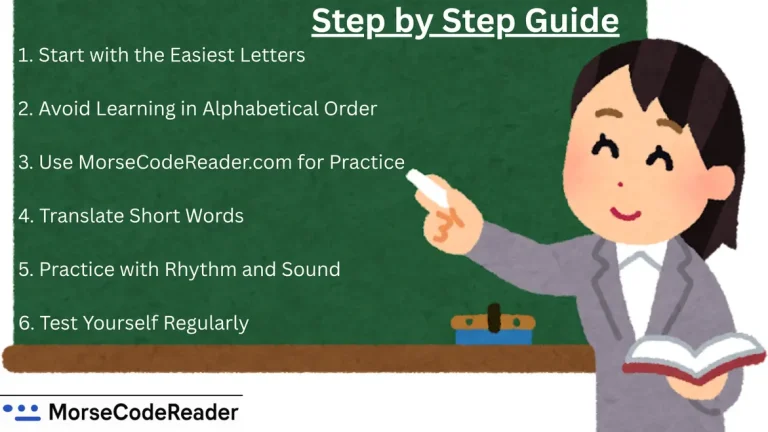
1. Start with the Easiest Letters
Begin with the shortest codes. E (·), T (–), I (··), and M (– –) each use only one or two elements. They are fast to learn and immediately useful. Trying to memorize the entire morse code alphabet from A to Z in one go leads to confusion and slow retention. Keep things simple and learn short codes first. Then, add complexity gradually.
2. Avoid Learning in Alphabetical Order
Alphabetical order is not the most efficient learning sequence. Group letters by their pattern structure instead:
- Single-element: E (·) and T (–)
- Two-element: I, A, N, M
- Mirror pairs: K (–·–) and R (·–·) — same elements, reversed
- Dot-heavy: H (····), S (···), F (··–·)
- Dash-heavy: O (– – –), CH (– – – –), Y (–·– –)
Pattern grouping reduces the mental load and helps you spot relationships between letters. Operators who learn this way build recognition speed significantly faster than those who study A to Z in order.
3. Use Free Online Digital Tools for Daily Practice
Our morse code interpreter lets you encode and decode in real time. Use it daily. Even five to ten minutes of active practice beats an hour of passive reading. The Encoder tab on this page plays back any word or phrase at adjustable speed, so you can train your ear as you learn the patterns.
Set the speed slow at first (around 60–80 ms dot length). As recognition improves, increase the speed rather than lowering it. The goal is instant recognition — not slow decoding, one dot at a time.
4. Translate Short Words
Once you know ten to fifteen letters, start translating real words. Common short words like THE, AND, FOR, ARE, NOT are ideal — they reinforce the most frequent letters (T, H, E, A, N, D) while giving you a sense of real-world morse rhythm. Write the code by hand first, then check it against the morse code alphabet chart above. The act of writing deepens retention.
5. Practice with Rhythm and Sound
Proficient morse operators hear letters as sounds, not visual dot-dash patterns. The goal is for dah-di-dah to trigger the letter K instantly — without conscious decoding. To build this, always practise with audio. Use the play buttons in the chart above. Use the Tapping tab to tap along as you listen. Your brain learns morse as rhythm long before it can decode it visually.
The Farnsworth Method (used by ARRL) sends each character at full speed with extended gaps between letters. This lets you hear correct rhythm per letter without being overwhelmed by pace. Start Farnsworth at 20 WPM character speed, then gradually reduce the inter-character gap.
6. Test Yourself Regularly
Passive review is not the same as active recall. Test yourself regularly: cover the pattern column of the morse code alphabet chart and try to reproduce each code from memory. Use the Tapping tab to input morse and check the decoded output. Identify which letters you hesitate on — those are the ones to drill first in your next session. Consistency over intensity: short daily sessions outperform weekly marathons.
Pro Tip: Morse code isn’t just for history buffs. Thousands of players use these exact A–Z patterns to communicate secretly in games. Learn the specific tricks for Roblox Morse code here.
Fast‑Track Your Morse Code Memory: Smart Tricks That Work
Rote memorization works — but these techniques work faster. Each one is grounded in how the brain encodes and retrieves information.
1. Build Stronger Recall with Word‑Based Mnemonics
Pair each letter with a word whose spoken rhythm matches its morse pattern. The mnemonic column in the morse code alphabet chart above gives you one for every letter. For example:
- C (–·–·) → “CaCTus” — the stressed syllables mirror the dah-dit-dah-dit pattern
- H (····) → “H·ello” — four short sounds, four dots
- V (···–) → “V·ictor” — three dits and a dah (also Beethoven’s famous opening)
Create your own if the ones here don’t stick. Personal associations are more memorable than borrowed ones.
2. Listen, Feel, Learn – Sound & Rhythm Based
Say the codes aloud using the words “dit” (dot) and “dah” (dash). Q becomes “dah-dah-dit-dah.” Say it as a single phrase, repeatedly, until it becomes automatic. Many experienced operators swear by this method — hearing the pattern without seeing it forces faster recall.
3. Map Out the Codes Visually
Some learners find the Morse tree useful. It’s a binary branching diagram where each branch leads left for a dot and right for a dash. Starting from the root, two branches reach E and T. Four branches reach I, A, N, M. Each level adds letters of increasing code length. Trace the path for any letter and the pattern becomes a physical route through the tree — easier for visual learners to internalise than a flat list.
4. Cluster Letters with Matching Patterns
Mirror pairs are especially useful: K (–·–) and R (·–·) are each other’s reverse. Same with U (··–) and D (–··), or W (·– –) and G (– –·). Learn one, then flip it to get the other. This halves the memorisation work for paired letters and reinforces the underlying structure of the morse code alphabet.
5. Play, Flash, Tap – Practice Morse Right Here
The Tapping tab above simulates a real iambic paddle. Tap DOT and DASH with your mouse or use F and J keys on your keyboard. The decoder reads your tapped sequence and shows the letter in real time. Immediate feedback is one of the most powerful learning accelerators — you know within one second whether you tapped correctly or not.
6. Give Every Letter a Musical Hook
Set the dit-dah patterns of each letter to a simple melody. Several popular morse learning songs map the entire morse code alphabet A to Z to nursery rhymes or folk tunes. The rhythm of the song matches the rhythm of the code. Music memory is among the most durable forms of recall the brain has — a melody you learned twenty years ago is far easier to retrieve than a list you memorised last week.
7. Make Regular Revisions a Habit
Spaced repetition works. Review the letters you know every few days, increasing the interval each time. Focus extra sessions on letters you consistently get wrong. After two weeks of daily ten-minute sessions, most learners can recognise the full morse code alphabet at a basic reading pace. After four to six weeks, rhythm-based listening becomes possible.
✈️ The A‑Z of Morse in Today’s World – Practical Applications
The morse code alphabet is not a museum exhibit. It is an active communication tool in four distinct professional fields today.
Aviation & Aeronautical Navigation
VOR and NDB radio navigation stations still transmit their 2–3 letter identifier in Morse every 30 seconds. Pilots cross‑reference these Morse identifiers to confirm they are tracking the correct station — a direct, mandatory use of the Morse alphabet in modern aviation, mandated by ICAO.
Maritime Communication & Distress Signalling
SOS (···–––···) remains the internationally recognised distress call — transmittable by radio, flashlight, or any on/off signal source. Coast guards worldwide train personnel to recognise it, and merchant vessels carry flashing signal lamps as backup communication.
Amateur Radio (HAM) Operations
CW (Continuous Wave) Morse is the most spectrum‑efficient mode in amateur radio, punching through interference where voice fails. The ARRL CW Sweepstakes and CQ WW CW Contest draw thousands of operators annually. Many operators earn CW credentials because the skill is both respected and practical during poor propagation.
Emergency & Survival Scenarios
Morse requires the simplest equipment: two rocks, a mirror, a whistle, a torch — any on/off source can send Morse. Military survival training includes basic Morse literacy for this reason. Knowing even fifteen to twenty letters can be enough to signal for rescue when all other communication fails.
🎮 Playful & Engaging Ways to Master the Morse Alphabet
Drilling dots and dashes from a chart gets dry fast. These methods keep practice engaging — and effective.
Flashlight Signal Challenge
Use a torch or your phone’s flashlight to send Morse across a room or out a window at night. The physical act of controlling a light source builds real transmission skill. Start with simple words — your name, SOS, short greetings — and have a partner decode using the Morse alphabet chart. This mirrors real maritime and military signalling.
Two‑Player Tap Duel
Two players. One taps a letter using the Tapping tab (or by knocking on a table). The other decodes without looking at the chart. Switch roles after each letter. First to correctly identify ten letters wins. This builds listening and sending skills simultaneously, and the competitive edge sharpens focus far better than solo practice.
Apps & Online Simulators
Our Morse interpreter encodes/decodes in real time. Dedicated apps like Morse Mania, Morse Trainer by IZ2UUF, and the LCWO (Learn CW Online) platform offer structured lessons, speed drills, and callsign practice. LCWO’s Koch method starts with K and M at full speed, adding new letters only when accuracy hits 90% — the most evidence‑backed approach to fluency.
Design Your Own Morse Puzzle
Write a short message using the Encoder tab, copy the dots and dashes, and challenge a friend to decode it without help. Or set a timer. Using the Morse alphabet copy‑and‑paste output from our encoder, you can embed challenges in messages, emails, or even social posts. Morse‑encoded messages carry a novelty that makes people genuinely want to decode them — so your challenge will actually get solved.
📡 Why Morse Code Still Matters in the Digital Age
Digital communication is fast, convenient, and ubiquitous. So why does the Morse alphabet still have a place?
Unmatched Resilience
Morse works when everything else fails. It requires no internet, no phone network, no shared software, no battery‑hungry device. A piece of wire, a power source, and timing — that’s all. In natural disasters, Morse‑capable operators have sent distress calls when no other channel was available.
Life‑Changing Accessibility
Morse is increasingly used in assistive technology. People with limited motor control — ALS, locked‑in syndrome, severe physical disabilities — use two‑switch Morse input to type text at speeds rivaling conventional keyboards. A dot switch and a dash switch are enough. This quiet application of 19th‑century technology is one of its most remarkable modern uses.
Superior Signal Efficiency
CW Morse occupies roughly 150 Hz of bandwidth — far less than voice (3 kHz) or digital modes. In crowded radio spectrum or interference‑heavy conditions, a well‑timed Morse signal gets through when nothing else does. Amateur radio operators experience this regularly on HF bands during solar storms or high‑interference periods.
Brain‑Training Power
Learning the Morse alphabet trains pattern recognition, auditory discrimination, and working memory simultaneously. Skilled operators process it like reading — as direct decoding of meaning, not sequential symbol analysis. It’s a genuine language skill, not just a code to crack.
Cultural & Historical Link
Morse connects learners to a lineage of communicators stretching back to 1844. The same patterns that enabled the first transatlantic cable, coordinated naval battles, and saved lives at sea are the same patterns used by every HAM operator today. That continuity has value — historical, technical, and human.